Landmark Athens, Greece
Cats in The Ancient Agora
The two agoras under the Acropolis, Greek and Roman, are ruins with cats on the column drums, and the lanes of Plaka and Anafiotika above them are where the cats go home. Fed by the guards, the tavernas and a volunteer group that has neutered thousands.
Where to find cats in The Ancient Agora: The Ancient Agora and the Roman Agora, on the north side of the Acropolis in Athens, and the lanes of Plaka and Anafiotika above them. When: Opening time, eight in the morning, when the guards feed and the stones are cool. October to May; the summer afternoons are for nobody. Why here: Cats on the stones where Socrates argued, fed by the people who guard them.
The short version
- Where
- The Ancient Agora and the Roman Agora, on the north side of the Acropolis in Athens, and the lanes of Plaka and Anafiotika above them
- When
- Opening time, eight in the morning, when the guards feed and the stones are cool. October to May; the summer afternoons are for nobody
- How long
- Two hours for both agoras. Half a day with Plaka and Anafiotika
- What it costs
- A combined ticket covers both agoras and the Acropolis. Plaka is free
- Why here
- Cats on the stones where Socrates argued, fed by the people who guard them
What to bring
- The combined ticketIt covers the Acropolis and both agoras for several days. Buy it at the Ancient Agora gate, where the queue is short.
- Eight in the morningThe gates open, the guards put the food down, and the cats are on the column drums before the first tour group.
- Shoes for marbleTwo thousand years of polish. The Agora paths are gravel; the lanes of Anafiotika are steps.
- Something for Nine LivesThe volunteer group has neutered and fed the cats of central Athens for nearly twenty years. Its website says how.
Why there are cats everywhere
The market square where Athens invented politics is now a garden of ruins, and the cats have the best seats.
The Ancient Agora was the centre of Athenian life for a thousand years: the market, the law courts, the council, the place Socrates asked his questions and the place he was tried. What is left is a garden of column drums, foundations and a reconstructed stoa that houses the museum, with the Temple of Hephaestus, the best-preserved Greek temple anywhere, on the rise at the west end. Next door, on the other side of the flea market, the Roman Agora is the smaller market the Romans built, with the Tower of the Winds at its corner.
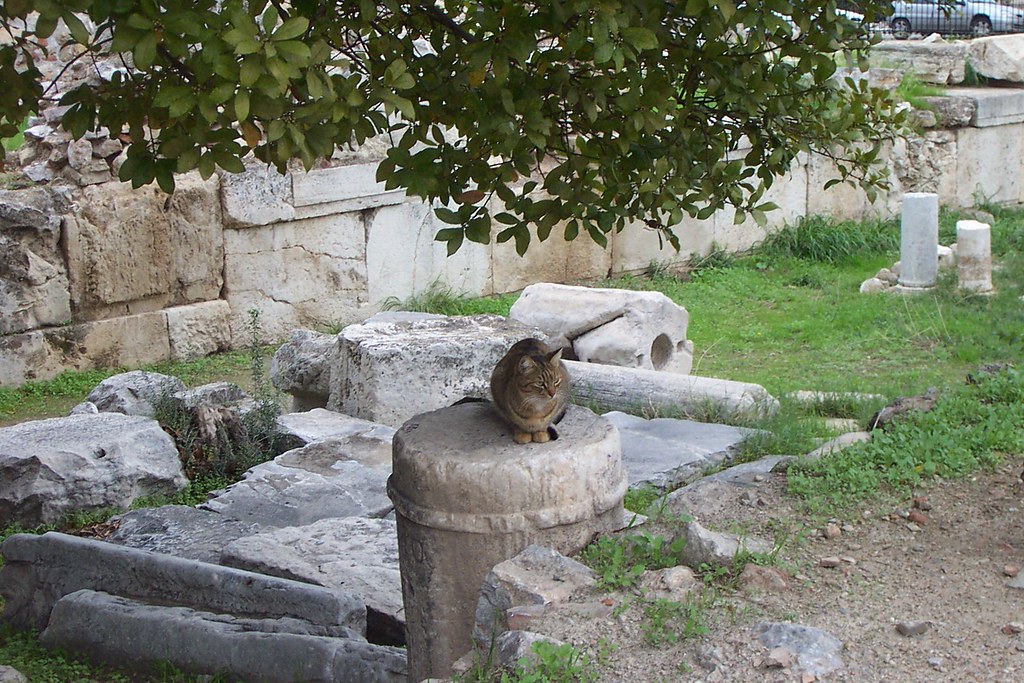
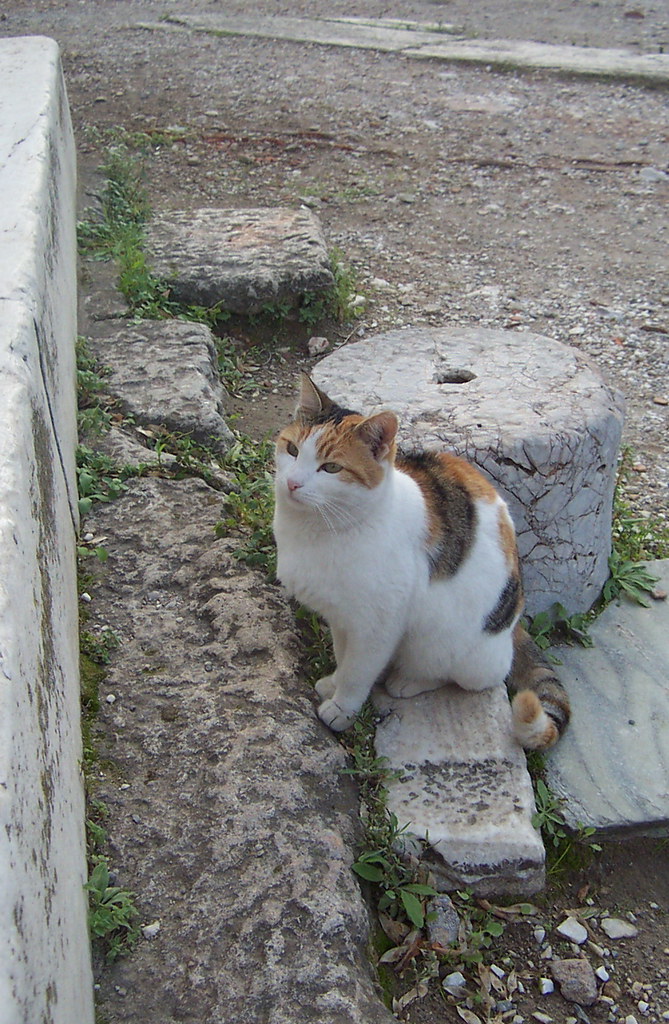
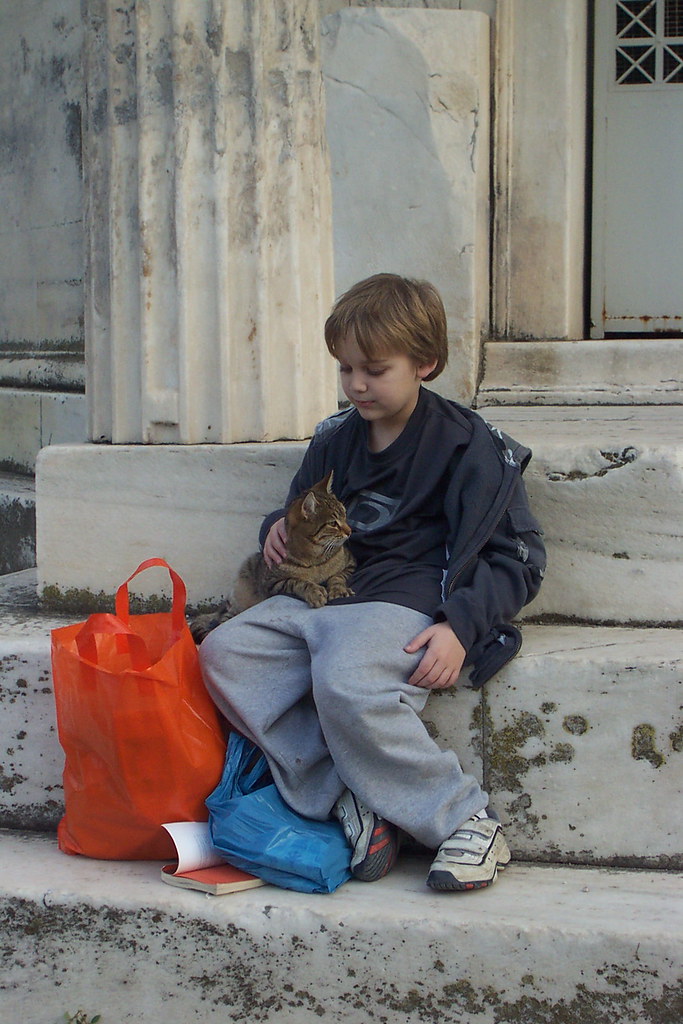
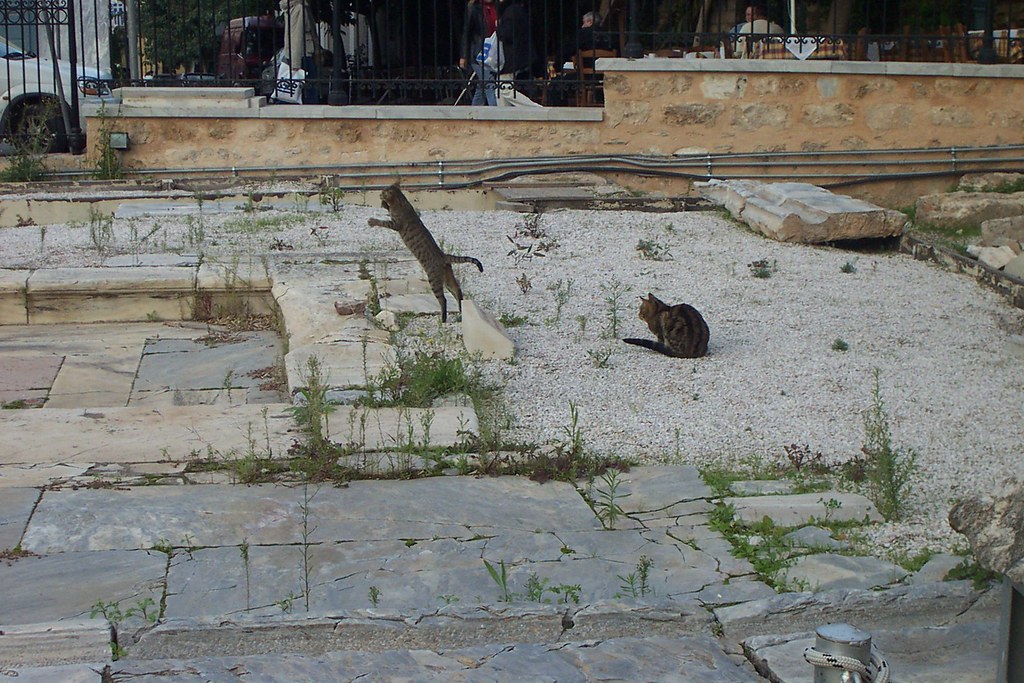
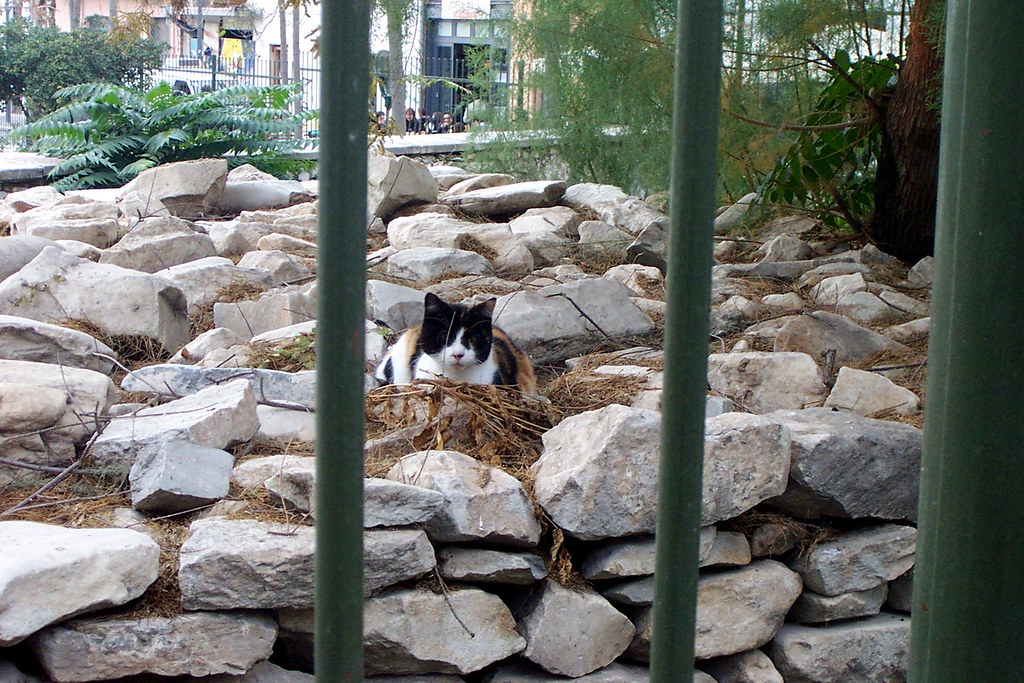
Both have cats. They live in the ruins, which are warm, dry and closed at night, and they are fed by the site guards and, in the Roman Agora, by the tavernas whose tables back onto the fence. The photographs on this page are from the Roman one, where the cats have learned that a visitor sitting on a stone is a lap, and where a good day involves a mouse. Above both, the lanes of Plaka and the whitewashed island-village of Anafiotika, built on the Acropolis slope by workers from the Cyclades, are where the cats spend the evening.
Athens has a great many street cats and, since 2006, a volunteer group, Nine Lives Greece, that feeds, neuters and rehomes them across the centre. The cats you meet in the agoras are on their rounds, and the ear tips are their work. Give them something.
The walk
The Ancient Agora at opening, across to the Roman Agora, then up through Plaka to Anafiotika under the Acropolis wall. A morning, all of it uphill in the end.
- From Athens airportMetro line 3 to Monastiraki45 minThe Ancient Agora gate is a five-minute walk from the station.
- From SyntagmaWalk through Plaka15 minDownhill through the old town to the agoras. The best way to arrive.
- From PiraeusMetro line 1 to Thiseio or Monastiraki25 minThiseio is at the west gate of the Ancient Agora, by the temple.
The Ancient Agora
In at the gate on Adrianou Street at eight. The Stoa of Attalos with the museum on your left, the Temple of Hephaestus on the rise ahead, and cats on the foundations between, where the guards have put the food.
Waiting for attention. The ruins have a lot of it to spare.mamamusings, CC BY-SA 2.0 The Roman Agora
Out and east along Adrianou, through the flea market, to the smaller Roman market with the Tower of the Winds. This is where the photographs are from: cats on the drums, at the fence, and, on a good day, with a mouse.
A good day in the Roman Agora, from the cats’ side of it.mamamusings, CC BY-SA 2.0 Plaka
Up into the old town under the Acropolis: lanes, tavernas, bougainvillea, and cats under every table. The tavernas along the fence of the Roman Agora feed the same cats you have just seen inside.
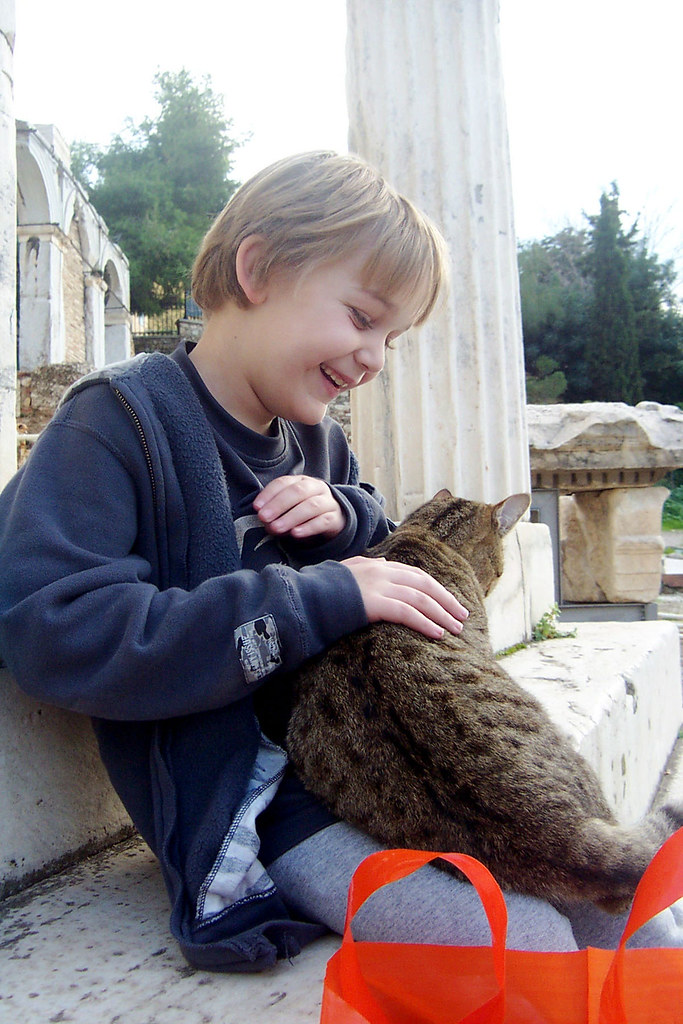
A visitor, a cat, and the agreement between them.mamamusings, CC BY-SA 2.0 Anafiotika
The highest lanes, a whitewashed Cycladic village built into the slope under the Acropolis wall by island builders in the eighteen-hundreds. Steps, blue doors, and cats on all of them. The view is the whole city.
Through the fence. Both sides have cats; both sides have tavernas.mamamusings, CC BY-SA 2.0
Same numbers as the list. Worth keeping open on your phone.
The cats you will meet
Athenian street cats: tabby and ginger and calico, short-coated, well fed by guards, tavernas and volunteers, and expert at the lap. Ear-tipped by Nine Lives Greece in good numbers. Sociable in the ruins, asleep in Anafiotika.
Ruin cats
On the column drums and foundations.
Fed by the guards at opening. Sit on a stone and one arrives.
Fence cats
At the taverna fence of the Roman Agora.
Fed from both sides. Doing well.
Anafiotika cats
On the steps of the whitewashed lanes.
The residents’. Photograph from the lane.
Everybody says The cats are damaging the ruins.
Actually Cats sit on stone. What damages ruins is people climbing on it for photographs, which is why the guards shout. The cats are fed by the same guards and are, if anything, the site’s pest control.
How not to be the annoying one
- Stay on the paths and off the stones. The guards are watching, and rightly.
- Do not feed in the sites. The guards do, and the ruins are not a picnic ground.
- At a Plaka taverna, the cat under the table gets the fish skin, not the bread.
- Anafiotika is a village of homes. Quiet, and no sitting on doorsteps.
- Give to Nine Lives Greece. The ear tips are theirs.